OpenAI’s Astra and the AGI Debate: What the New Model Means

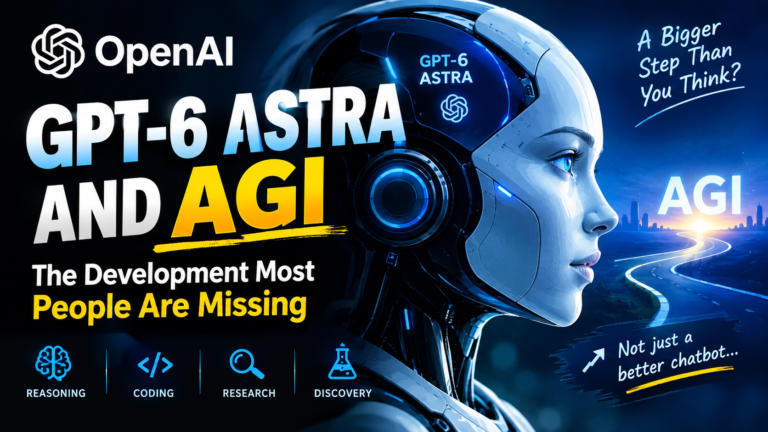
OpenAI has launched GPT-6 Astra and described the release as the beginning of a new era of artificial general intelligence. That is a major claim, but it is important to separate a company’s definition of AGI from an independent scientific consensus.
Reuters reported that OpenAI is positioning Astra as its most capable model so far, with stronger performance across tasks including software work, professional workflows and cybersecurity. The release has intensified questions about how increasingly autonomous AI systems should be evaluated and monitored.
What OpenAI means by AGI
OpenAI has used an economic definition of AGI: broadly, an AI system capable of outperforming humans at most economically valuable work. Other researchers emphasize different criteria, including generalization, learning new tasks, autonomy and reliability.
That means the AGI label should be treated as a description of a capability threshold, not a universally agreed scientific measurement.
Why Astra matters
The significance of frontier AI is increasingly about completing long, multi-step tasks. Models are being connected to browsers, coding environments, enterprise software and other tools. This turns an AI system from a passive answer generator into something closer to an operator.
The upside is obvious: more useful automation. The challenge is that mistakes become more consequential when systems can act for longer and interact with external software.
Does Astra prove AGI has arrived?
Not by itself. A company’s announcement is evidence about its own assessment, not a universal scientific verdict.
A stronger evaluation would combine independent benchmarks, long-horizon tasks, robustness tests, human comparison, failure analysis and evidence about how much supervision the system requires.
What to watch next
- Reliability: Does performance hold across long tasks?
- Autonomy: How much human intervention is required?
- Tool use: Can the system safely operate external software?
- Cybersecurity: How do new capabilities affect defensive and offensive risk?
- Independent testing: Do outside evaluations reproduce the strongest claims?
- Economic impact: Which jobs and workflows actually change in production?
The bigger story
Whether Astra ultimately deserves the AGI label may be less important than the underlying trend: frontier AI systems are moving toward broader, more autonomous computer-based work.
That makes capability measurement, security engineering and human oversight central parts of the AI story. The next stage of AI will not be judged only by what a model can say. It will be judged by what it can reliably do.
Source: Reuters coverage of OpenAI’s Astra launch.
For background, read What Is AGI? and follow our AI News coverage.




3 Comments