UPI Fee Changes 2026: What the New Rules Mean for Users and Merchants
UPI fee changes 2026 are set to reshape the economics of India’s digital payments ecosystem, with a new merchant discount rate (MDR) applying to specified UPI payments above ₹2,000 from October 15, 2026.
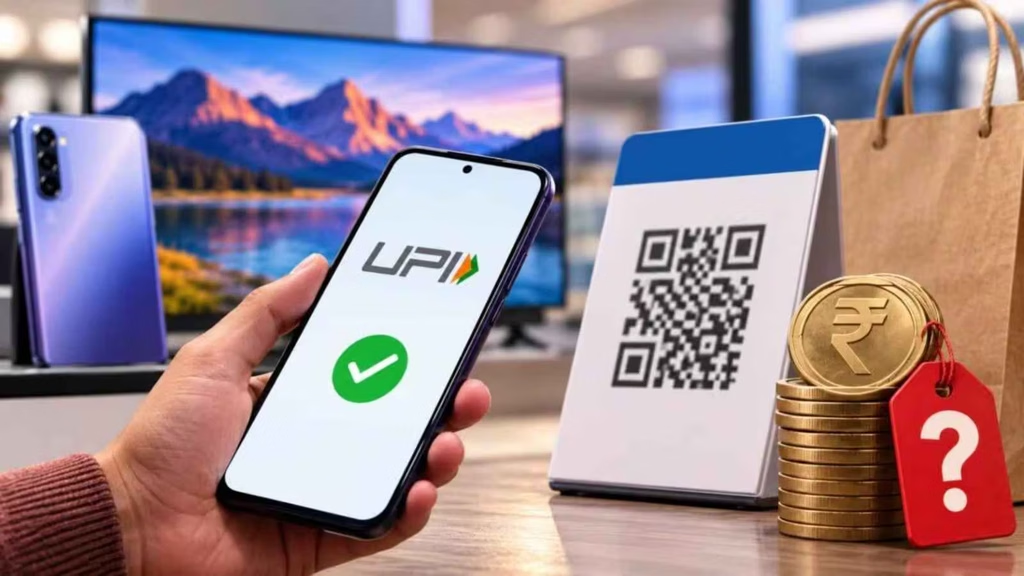
The announcement marks a significant change after more than six years of a zero-MDR framework for UPI. However, the new rules do not mean that ordinary users will suddenly have to pay a fee every time they use UPI.
Person-to-person payments will remain free, while UPI merchant payments up to ₹2,000 will also remain under the zero-MDR framework. The government has also said that around 96% of all person-to-merchant transactions will remain unaffected.
So, what exactly is changing, who will pay the new fee, and what does it mean for India’s fast-growing digital payments ecosystem?
What Are the New UPI Fee Changes in 2026?
Under the revised framework, a 0.4% Merchant Discount Rate will apply to specified person-to-merchant UPI transactions above ₹2,000.
The new framework will take effect from October 15, 2026.
The MDR is a fee associated with merchant transactions within the payments ecosystem. It is not designed as a direct transaction charge on consumers using UPI.
The government has clarified that the new MDR is neither a tax nor a government charge. Instead, it is distributed among participants in the payments ecosystem, including banks and payment application providers.
Reuters’ latest report on India’s UPI fee shake-up explains how the new system marks a shift away from the long-standing zero-MDR model.
Will Users Have to Pay for UPI Payments?
For most everyday users, the answer is no.
Person-to-person UPI transfers will remain free regardless of the amount transferred.
For example, if you send ₹5,000 to a friend or family member using UPI, the new merchant MDR does not apply to that transaction.
The government has also clarified that UPI payments up to ₹2,000 to merchants remain protected under the zero-MDR framework.
This means the headline about “UPI charges” does not mean that consumers will automatically be charged for every UPI payment.
Who Will Pay the New UPI MDR?
The new MDR primarily applies to specified person-to-merchant (P2M) transactions above ₹2,000.
This means the change is more directly relevant to merchants, banks, payment service providers and other participants in the UPI ecosystem than to people transferring money to one another.
The government has also said that banks should ensure merchants do not pass the MDR directly to consumers as an additional UPI payment charge.
Example of the New UPI Fee
Suppose a customer makes a qualifying merchant payment of ₹5,000 through UPI.
At a 0.4% MDR, the basic MDR amount would be:
₹5,000 × 0.4% = ₹20
The actual treatment can depend on the transaction category and applicable rules, including exemptions and caps.
Therefore, consumers should not interpret the 0.4% MDR as a universal fee that will automatically be added to their UPI bill.
Which UPI Transactions Will Remain Free?
The revised framework keeps several important categories outside the new merchant fee structure.
- Person-to-person UPI payments remain free.
- UPI merchant payments up to ₹2,000 remain under the zero-MDR framework.
- Small merchants covered by the specified zero-MDR framework remain protected.
- Several essential-service and specified transaction categories have separate treatment.
The Ministry of Finance has stated that approximately 96% of all P2M transactions will remain unaffected by the new framework.
This means the change is targeted rather than a blanket charge on India’s UPI users.
Why Is India Introducing UPI MDR Now?
UPI has grown into one of the world’s largest real-time digital payment systems.
According to NPCI’s official statistics, UPI processed approximately 24.51 billion transactions worth ₹29.82 lakh crore in August 2026.
At this scale, maintaining the infrastructure behind UPI requires substantial investment in technology, security, reliability and capacity.
For years, the zero-MDR model helped encourage rapid adoption of digital payments. However, payment companies and banks have also faced the economic challenge of supporting enormous transaction volumes without a conventional merchant fee structure.
The new framework is therefore intended to create a transaction-linked revenue mechanism while keeping most everyday UPI payments free.
How Much Is the New UPI Merchant Fee?
The standard MDR for specified merchant UPI payments above ₹2,000 is 0.4%.
However, the framework includes different treatment for certain sectors and transaction categories.
For specified essential services and other categories, a flat fee structure can apply instead of the standard percentage-based MDR.
Some high-value transactions also have an overall cap on the applicable MDR.
These distinctions are important because the new rules are not simply a single fee applied to every UPI transaction above ₹2,000.
What Happens to Small Merchants?
Small merchants are an important part of India’s UPI ecosystem.
Street vendors, neighbourhood shops and small businesses have helped make QR-based digital payments common across urban and rural India.
The revised framework provides zero-MDR treatment for merchants covered under the specified small-merchant category.
This is intended to protect small businesses while introducing a fee mechanism for qualifying larger-value merchant transactions.
Why the UPI Fee Change Matters for Fintech Companies
The new UPI MDR framework could create an additional revenue stream for banks, payment applications and other ecosystem participants.
Reuters reported that investors responded positively to the announcement, with shares of several Indian payment companies moving higher as markets assessed the potential revenue impact.
Analysts cited by Reuters have estimated that the new framework could create a substantial annual revenue pool, although the eventual benefit for individual companies will depend on transaction mix, exemptions and how the revenue is distributed.
This could become particularly relevant for fintech companies that have invested heavily in building payment infrastructure and acquiring merchants.
What Does the UPI Change Mean for Digital Payments in India?
India’s digital payment ecosystem has expanded rapidly over the past decade.
UPI made instant bank-to-bank payments easier for consumers and businesses, while QR codes helped even small shops accept digital payments without traditional card terminals.
The new MDR model represents a shift in how that ecosystem is funded.
Instead of relying almost entirely on a zero-MDR structure, the system will introduce transaction-linked revenue for qualifying merchant payments.
The broader objective is to maintain UPI’s expansion while supporting investment in infrastructure and resilience.
Will UPI Become Expensive Like Credit Cards?
Not necessarily.
UPI and card-payment economics are different, and the new MDR framework applies only to specified transactions.
Person-to-person UPI payments remain free, while many merchant payments are also excluded from the new charge.
The government’s framework therefore does not turn UPI into a conventional paid payment service for consumers.
Instead, it introduces a merchant-side revenue mechanism for qualifying transactions.
How UPI’s Growth Is Changing India’s Fintech Industry
The scale of UPI has also changed India’s fintech landscape.
Payment applications, banks and financial technology companies have built businesses around the growth of digital transactions.
As UPI volumes continue to rise, the ability to generate sustainable revenue from the ecosystem is becoming increasingly important.
The new MDR framework could therefore influence how fintech companies invest in payment infrastructure, merchant acquisition and new financial services.
It could also change the competitive dynamics between banks, payment apps and payment aggregators.
What Businesses Should Know About the New UPI Rules
Businesses accepting UPI payments should review the new MDR framework before it comes into effect.
1. Check Your Merchant Category
Businesses should determine whether their transactions fall within the categories covered by the new MDR.
2. Review Payment Costs
Companies should assess how the revised MDR could affect their payment-processing costs.
3. Do Not Automatically Add a UPI Fee to Customers
The new MDR is not the same as a consumer transaction fee.
Businesses should follow the applicable rules rather than automatically adding a separate UPI charge to customers.
4. Review Payment Providers
Merchants should check how their acquiring bank, payment provider or aggregator will implement the revised framework.
UPI and the Future of India’s Digital Economy
The UPI fee changes 2026 are important not only because of the new MDR but also because they represent a new phase in India’s digital payments story.
UPI has already become deeply integrated into everyday commerce, from large online purchases to small QR-code payments at local shops.
The next challenge is ensuring that the infrastructure supporting that growth remains reliable, secure and financially sustainable.
This is particularly important as digital payments become increasingly connected with banking, fintech, e-commerce and other technology services.
How UPI Changes Could Affect Consumers
For ordinary consumers, the immediate impact should be limited because person-to-person transfers remain free and most P2M transactions remain unaffected.
However, consumers should still understand the difference between an MDR paid within the payments ecosystem and a direct fee charged to a customer.
If a merchant attempts to add an additional UPI fee to a customer, users should check the applicable rules and the merchant’s payment provider before assuming that the charge is officially required.
Frequently Asked Questions About UPI Fee Changes 2026
Will UPI become chargeable for users from October 15, 2026?
No. Person-to-person UPI transactions will remain free, and qualifying merchant payments up to ₹2,000 will also remain under the zero-MDR framework.
What is the new UPI MDR rate?
A 0.4% MDR will apply to specified person-to-merchant UPI transactions above ₹2,000 from October 15, 2026, subject to applicable exemptions, categories and caps.
Will I pay a UPI fee when sending money to a friend?
No. Person-to-person UPI transactions remain free regardless of the amount transferred.
Will small shops have to pay UPI MDR?
Small merchants covered under the specified zero-MDR framework remain exempt from the new merchant charge.
When will the new UPI MDR rules start?
The revised framework is scheduled to take effect from October 15, 2026.
Is UPI MDR a government tax?
No. The government has clarified that MDR is not a tax or a government charge. It is a payment-ecosystem fee distributed among relevant participants.
Conclusion
The UPI fee changes 2026 mark an important shift in India’s digital payment ecosystem after years of zero MDR.
The biggest clarification for consumers is that UPI is not simply becoming a paid service. Person-to-person transfers remain free, and payments to merchants up to ₹2,000 continue to receive zero-MDR treatment.
The new 0.4% MDR primarily affects specified merchant transactions above ₹2,000, with exemptions and special treatment for certain categories.
For businesses and fintech companies, however, the change could have a much broader impact by creating a new revenue model for parts of the UPI ecosystem.
As India’s digital payments continue to expand, the key challenge will be balancing affordability for users with the investment required to maintain a secure, reliable and scalable payments infrastructure.
For more updates on technology, fintech, digital payments and business trends, visit MNCUpdates and follow the latest developments in India’s technology ecosystem.